Stretchcare - Bodywork and Movement Therapy
  • Home
  • About
  • Services
    • Bodywork & FST
    • Habit Coaching
  • BOOK APPOINTMENT
  • Blog
  • Home
  • About
  • Services
    • Bodywork & FST
    • Habit Coaching
  • BOOK APPOINTMENT
  • Blog

Stretch  care  blog

7 Functional Movements for Optimized Health

10/9/2023

 
Exercise is often top of mind when you think of a healthy lifestyle. However, not all forms of exercise are created equal or work for everyone. While sweating it out at the gym can certainly have its benefits, there is one form that is more fundamental to our general well-being: functional movement. There are seven basic functional movements to know, and each one mimics our daily actions, like bending, grabbing, lifting, pulling, and more.

The Foundations of Functional Movement
Functional movement refers to the ability to perform everyday tasks with ease and efficiency. It's about moving your body in ways that align with how you naturally move throughout the day. While aesthetic goals like sculpted muscles or six-pack abs have their place, functional movement focuses on improving your body's functionality, reducing the risk of injury, and enhancing your overall quality of life.

One might incorporate more functional movement into their training when they begin to notice irregularities in their daily tasks, like difficulty tying their shoes. If bending down to tie your shoe is troublesome, there may be an issue with hamstring or lower back mobility. Working with a trained movement therapist to create a custom plan can help strengthen those weaknesses and improve those areas. 

Book your mobility assessment and learn exactly what you need to work on.
Free Movement Consultation
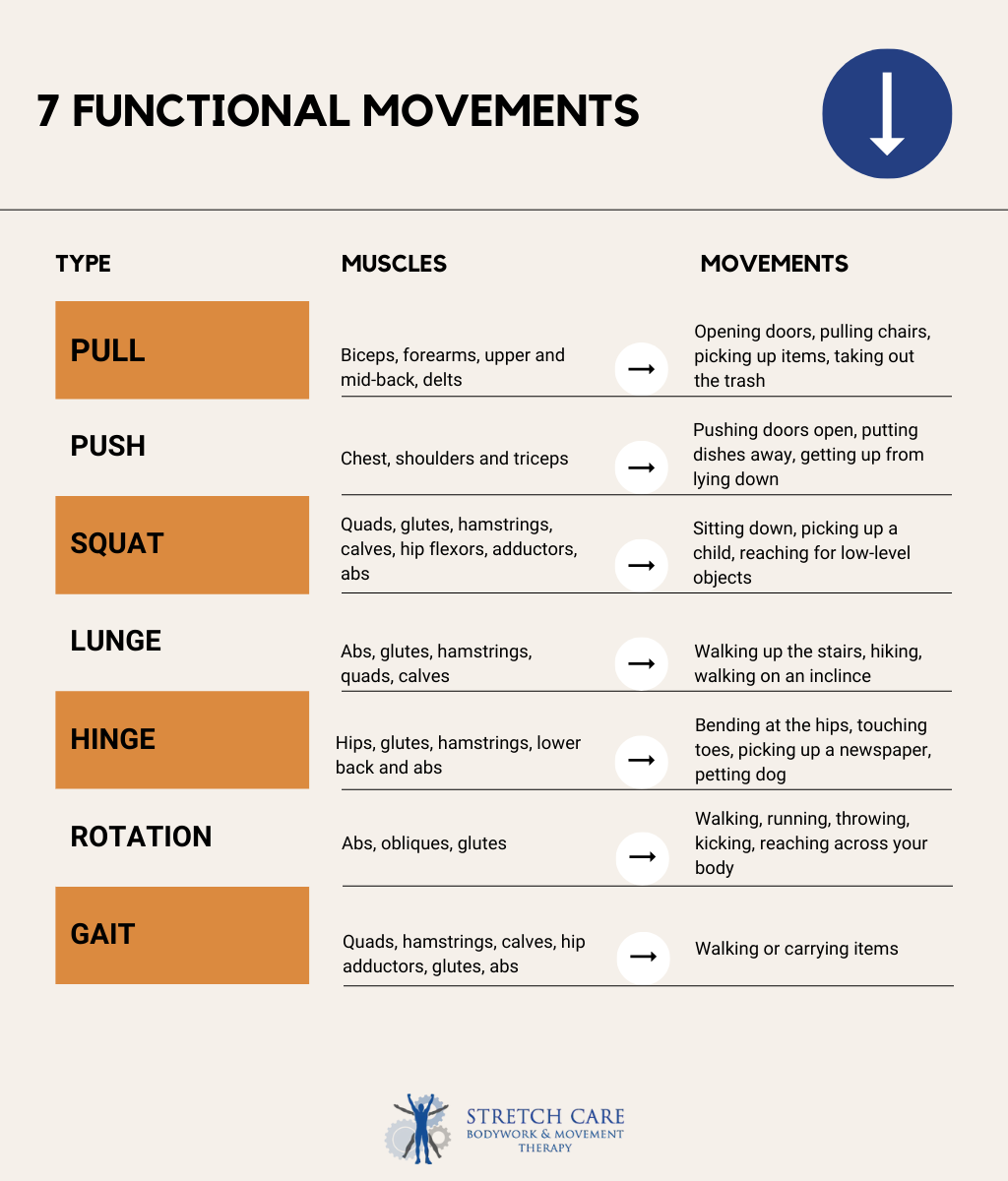
The 7 Essential Functional Movements
1. Push
The push movement involves extending your arms to push something away from your body. Think of pushing open a door, lifting a heavy box, or doing a push-up. Strengthening your pushing muscles, such as the chest, shoulders, and triceps, is essential for tasks that require upper body strength and stability.

2. Pull
Pulling movements involve bringing an object closer to your body or pulling yourself towards an object. Examples include pulling open a heavy door, lifting groceries, or doing pull-ups. Working on your pulling muscles, like the back and biceps, helps maintain a balanced musculature and supports good posture.

3. Squat
Squatting is a fundamental movement for sitting down and standing up. It engages the muscles of the lower body, including the quadriceps, hamstrings, and glutes. Proper squat mechanics are vital for maintaining mobility in your hips, knees, and ankles, preventing back pain, and ensuring you can quickly get up from a chair.

4. Lunge
Lunging involves taking a step forward or backward while bending your knees. It mimics climbing stairs, picking up objects, and walking on uneven terrain. Lunges strengthen the legs and enhance balance and stability, reducing the risk of falls as you age.

5. Hinge
The hinge movement pattern is essential for bending at the hips while keeping your spine neutral. It's used when lifting objects from the ground, like a heavy bag of groceries or your child. Strong hip hinges protect your lower back and maintain a healthy posture.

6. Rotation
Rotational movements occur when your body twists, which is necessary for tasks like reaching for something behind you or turning to look over your shoulder while driving. Rotational exercises can improve core strength, stability, and flexibility.

7. Gait
Gait is the pattern of movement when you walk or run. We walk daily, but paying attention to your gait can improve your overall posture, balance, and joint health. A proper gait ensures that your body moves efficiently and without pain.
Picture
The Benefits of Embracing Functional Movement
Incorporating these seven functional movements into your fitness routine is essential to better performance and quality of life… 

Improved mobility: Functional movements enhance joint flexibility and range of motion.

Reduced risk of injury: Strengthening your body through functional movements can help prevent common injuries in everyday life and athletic activities.

Enhanced balance and coordination: Promote better balance and coordination to improve overall performance in the gym, on the field and life in general. 

Increased functional strength: You'll be better equipped to handle everyday tasks efficiently and without strain. Think longevity! 

Better posture: Functional movements support good posture, alleviating back and neck pain. This is especially important for our desk warriors.

Efficiency in daily life: You'll find daily activities more manageable, from carrying groceries and crushing it on the court to playing with your children or grandchildren.

Functional movement is not just for athletes or fitness enthusiasts; it's for everyone who wants to maintain a high quality of life. By embracing these seven essential functional movements, you'll build a stronger and more resilient body and enjoy the countless benefits of improved health, mobility, and vitality in your daily life. So, start incorporating these movements into your fitness routine today and experience the transformative power of functional movement. 

Learn what functional movements are right for you with a complimentary movement consultation.

Free Movement Consultation

Comments are closed.

    Archives

    October 2023
    May 2023
    March 2023
    February 2023

    Categories

    All
    Habit Coaching
    Movement

CHECK US OUT ON SOCIAL!


Office Hours
by Appointment Only:

M - F   9am–5pm
SAT        Closed
SUN       Closed

Telephone:

Call or text:
​480-823-1877

Email:

[email protected], [email protected]
DISCLAIMERS
PRIVACY POLICY
TERMS AND CONDITIONS